Education AV · Lecture Halls & Auditoriums

Voice Reinforcement

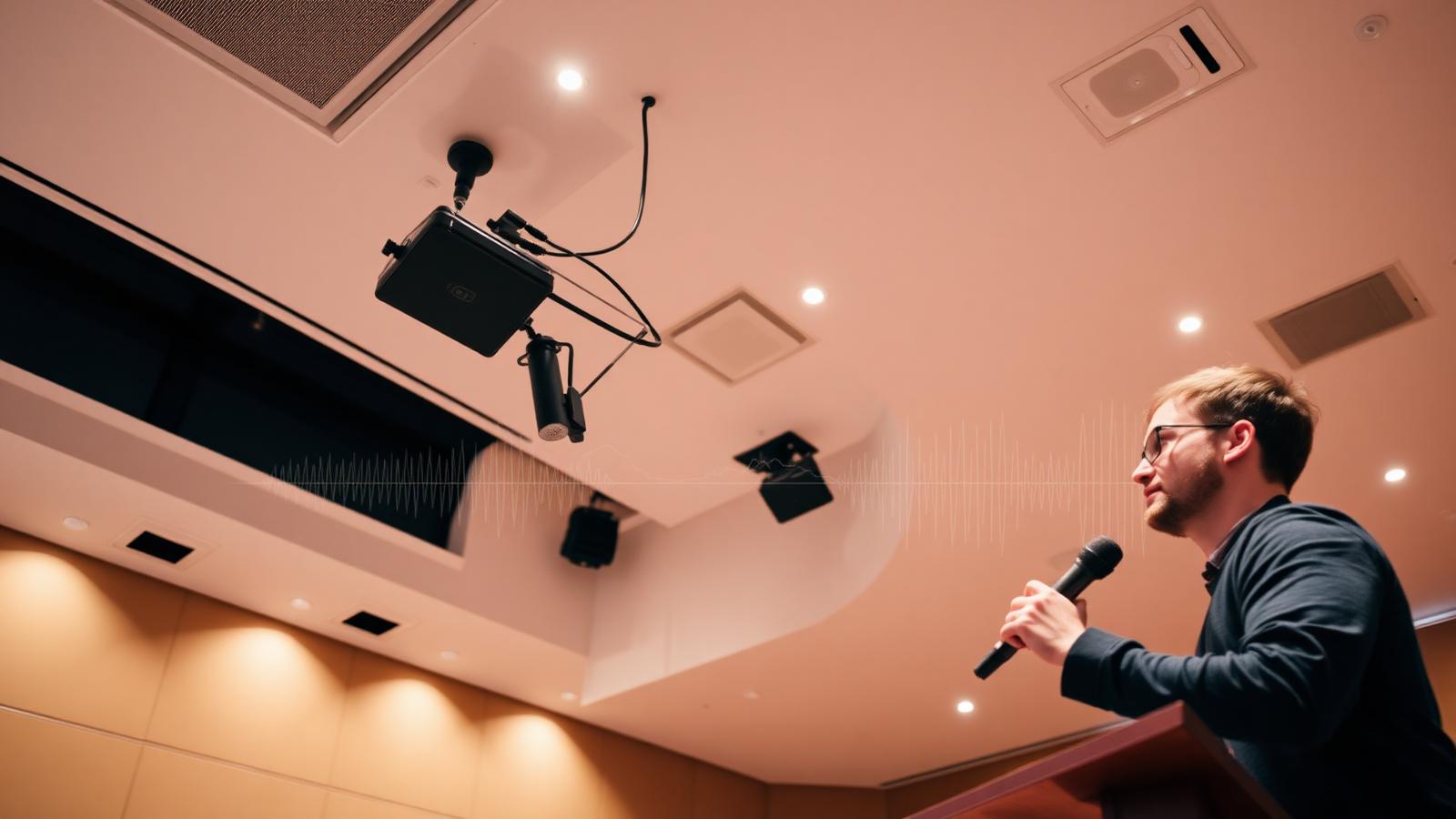
Ceiling arrays and lavalier systems with automixed clarity for large rooms.

©
Voice reinforcement in lecture halls

Voice Reinforcement

A focused motion preview for voice reinforcement within CaesarTechs' education av portfolio.

©
In-depth overview

A closer look at voice reinforcement.

Ceiling arrays and lavalier systems with automixed clarity for large rooms.

Within CaesarTechs' education av practice, voice reinforcement is engineered as a full stack — from source and processing to display, control, acoustics, network, and power. Every decision is made against the room, venue, or environment it operates in, so the finished system feels intentional rather than assembled from a parts list.

Our lecture halls & auditoriums teams pair proven manufacturer partners with in-house design and commissioning. That means the voice reinforcement you sign off in concept is the voice reinforcement you get in the field: color-matched, calibrated, and documented, with a clear service path after handover.

Projects typically move through discovery, concept design, technical design, procurement, installation, commissioning, and support. At each stage you get a named point of contact, a working prototype or mock-up when it matters, and change control that protects both budget and schedule.
What we design
  • Voice Reinforcement concept, sightlines, and viewing geometry
  • Education AV product selection with brand comparison
  • Signal flow, control, and network architecture
  • Structural mounting, power, cooling, and service access
  • Content, UX, and operator workflow
  • Commissioning, calibration, and acceptance testing
Typical use cases
  • Enterprise HQ voice reinforcement
  • Retail & hospitality voice reinforcement
  • Public venues & landmarks
  • Government & mission-critical
  • Broadcast, sports & entertainment
  • Education, healthcare & training
©
CaesarTechs Education standard

The teacher is heard at the back without raising their voice — and without the room sounding amplified.

©
How it works

From survey to a room teachers can actually use.

1Step

Model

Room volume, surfaces and reverberation time are assessed.

2Step

Distribute

Loudspeakers are laid out for even coverage rather than front-of-room volume.

3Step

Mix

An automixer manages lapel, handheld and student microphones without feedback.

4Step

Verify

Coverage and speech intelligibility are measured seat by seat at handover.

©
Products & systems

What goes into the room.

Category-level specifications with the features, the teaching benefit and the integration path — the detail procurement and consultants ask for.

Ceiling / distributed loudspeaker system in an education environment
Classrooms, flat-floor teaching rooms, laboratories.

Ceiling / distributed loudspeaker system

Even, low-level coverage across the seating area instead of one loud source at the front.

  • Distributed coverage design
  • Low listening level with high intelligibility
  • Ceiling, pendant or surface mounting
Benefit
Students at the back hear the same lesson as students at the front.
Integration
Driven by the room DSP and muted automatically during video calls to prevent echo.
FohhnITC TECHBosch
Teacher microphone system in an education environment
Every teaching space where the teacher moves around the room.

Teacher microphone system

Lapel or pendant transmitter with a charging dock at the teaching desk.

  • Lapel and handheld options
  • Docked charging
  • Automatic gain and feedback suppression
Benefit
Vocal strain drops and the lesson stays intelligible all day.
Integration
Automixed in the room DSP and shared with lecture capture and video calls.
BoschITC TECH
©
Interactive room lab

Size the image and the coverage from the back row.

Enter the room and CaesarTechs derives the minimum image height, an equivalent diagonal and the loudspeaker count for even coverage — the same first-pass model our engineers use on site.

Minimum image height
2.33 m
Analytical viewing (depth ÷ 6)
Detailed-content height
3.50 m
Dense text or CAD (depth ÷ 4)
Equivalent 16:9 diagonal
153"
Nearest standard size rounds up
Loudspeakers for even coverage
6
Distributed layout, first pass
At 14 m deep, 24 pt source text needs at least a 2.33 m image height to stay legible from the last row. CaesarTechs verifies this on site before the display technology is fixed.
©
Application scenarios

Where this is deployed.

Large classroom

Voice lift so the teacher speaks normally and is heard everywhere.

Hybrid session

The same microphone feeds the room, the recording and the remote participants.

©
System architecture

The signal chain, end to end.

Documented as-built for every room family, so campus IT and facilities can support the estate without calling the integrator first.

MicrophoneDSP automixAmplifierDistributed loudspeakersCapture / UC feed
Speech intelligibility target set and measured, not assumed
Feedback margin verified with the microphone at the board
One shared audio bus for the room, the recording and the remote call
©
Supporting brands

Technologies behind the classroom.

Education deployments are built on CaesarTechs' represented portfolio — Samsung and JCV displays with approved audio, control and processing partners.

All CaesarTechs brands →
Fohhn logo
ITC TECH logo
Bosch logo
Samsung logo
JC Vision logo
Extron logo
Crestron logo
Barco logo
©
Continue in Education

More from lecture halls & auditoriums.

All Education AV pages →
©

Plan your voice reinforcement rollout.

Share your room schedule and CaesarTechs will return a room-family specification, drawings and a phased campus rollout plan.

©